What Baltimore Homeowners Need to Know About Termite Swarm Season
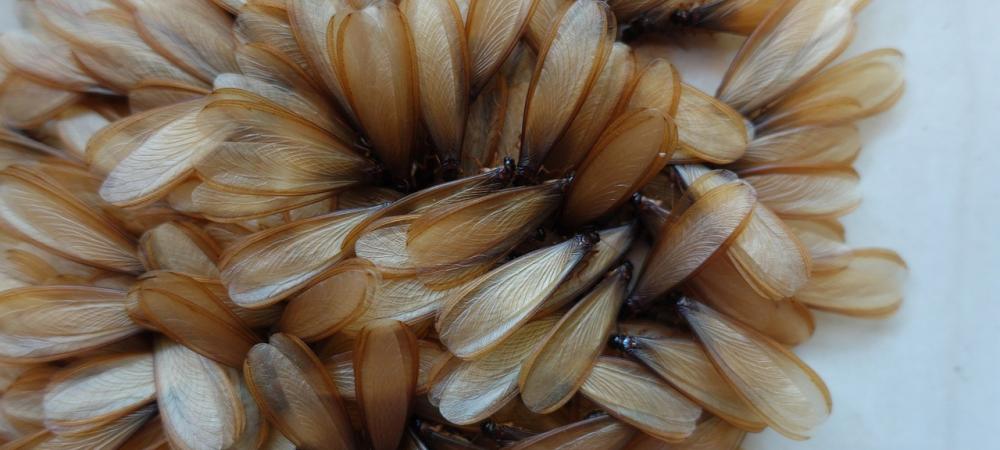
Those flying insects swarming your porch light or windowsill on a warm spring afternoon could be harmless flying ants, or they could be termite swarmers signaling a mature colony living near your home. Getting the identification right matters, because one is a nuisance and the other is a warning sign worth acting on.
Termite swarmers vs. flying ants: how to tell them apart
The two look similar at a glance, but three details separate them every time:
| Feature | Termite swarmer | Flying ant |
|---|---|---|
| Waist | Broad, no visible pinch | Narrow, clearly pinched |
| Antennae | Straight | Bent (elbowed) |
| Wings | Two pairs, equal length, extend well past the body | Two pairs, front wings noticeably longer than back wings |
If you can get close enough to check the waist and wings, that's the fastest way to know which one you're looking at. Both insects are usually seen for a matter of minutes before they shed their wings, so a phone photo before they scatter is worth more than a memory of what you think you saw.
When Baltimore's termite swarm season actually happens
Eastern subterranean termites — the species behind nearly every Baltimore-area swarm — typically fly between February and June, with the heaviest activity in 2026's spring stretch from March through May. Swarms happen during daylight, usually on a mild day with little wind shortly after rain. A single mature colony can release hundreds to thousands of swarmers in one event that lasts well under an hour, so seeing a large number at once doesn't mean a bigger problem than a smaller sighting — it just means you caught the flight.
What a swarm actually means, and what it doesn't
Termite swarmers don't chew wood and don't cause damage themselves — their entire function is to leave the colony, pair off, shed their wings, and start a new colony nearby. The real information in a swarm isn't the swarmers themselves; it's what they confirm. A colony has to mature for roughly five years before it produces swarmers at all, so seeing them means an established colony already exists close enough to reach your home, not that damage is actively happening at that moment. That distinction is worth knowing before assuming the worst, but it's also not a reason to wait: an established colony nearby is exactly the situation worth having inspected.
Why an indoor swarm carries more weight than an outdoor one
Where you see the swarmers matters. Swarmers spotted outside near the foundation or in the yard often indicate a colony in the soil nearby, which is common and worth a professional look but not necessarily inside your structure yet. Swarmers found indoors — along window sills, near baseboards, or emerging from a wall or ceiling gap — are a different situation entirely, since it means the colony they came from is very likely living inside the structure itself, not just somewhere in the yard. The University of Maryland Extension notes that a flight of swarmers indoors should always be investigated by a professional, since subterranean termites tunnel inside wood and can leave the exterior looking entirely normal while damage continues out of sight.
Subterranean vs. drywood termites: why the distinction matters here
Most termite content online covers two species: subterranean termites, which nest in soil and travel through mud tubes to reach wood, and drywood termites, which nest directly inside dry wood with no soil contact at all. Baltimore's climate supports subterranean termites almost exclusively — drywood termites are a warm-coastal and Gulf Coast problem, not a Maryland one. That matters practically: if you've read advice online about drywood termite treatment (localized wood injections, tenting), it doesn't apply to what's actually swarming in a Baltimore yard. Nearly every swarm here comes from the Eastern subterranean termite, and treatment for that species centers on the soil and foundation, not the individual piece of furniture or framing where swarmers happened to appear.
Why an infestation can go unnoticed for years
Subterranean termites spend the vast majority of their lives inside wood or underground, completely out of sight, which is why a colony can be active for years before a homeowner sees any evidence at all. The wood they tunnel through often keeps a normal-looking outer shell even as the interior is hollowed out, so tapping or visual inspection from a few feet away can miss real damage. A colony typically needs about five years to mature enough to produce swarmers in the first place, which means by the time you see a swarm, the colony itself isn't new — it's just now large enough to expand. That's part of why the swarm is worth treating as useful information rather than dismissing it as a one-time nuisance.
Can I handle a termite swarm myself?
Store-bought sprays and foams can kill the swarmers you can see, but they do nothing to the colony that produced them, which is still intact in the soil or wood regardless of how many flying insects you eliminate. Over-the-counter termite stakes and spot treatments face the same limitation: they can address a localized area, but subterranean termite colonies are large, spread through soil, and typically require a continuous barrier or bait system around the entire structure to actually eliminate rather than just interrupt. A homeowner treating only the spot where swarmers appeared is often treating the symptom while the colony continues elsewhere in the same soil network.
Warning signs beyond the swarm itself
Swarmers are often the most visible sign, but they're rarely the only one. Look for:
- Mud tubes about the width of a pencil running along the foundation, crawl space piers, or basement walls
- Small piles of shed, silvery wings on window sills, floors, or in spider webs after a swarm has passed
- Wood that sounds hollow when tapped, or paint that looks blistered or uneven
- Settling cracks, sagging floors, or sticking doors and windows with no other obvious cause
What a professional termite inspection actually covers
A real inspection goes past a visual check of the areas you already suspect. A technician traces the foundation perimeter for mud tubes, checks crawl spaces and basement sill plates for soft or damaged wood, probes areas of wood-to-soil contact outside (porch posts, deck ties, stair stringers), and looks for shelter tubes running down from framing members where termites travel between soil and wood without being exposed. Where an active colony is confirmed, ongoing protection typically relies on a baiting system such as Sentricon, which eliminates the colony at the source rather than just treating the areas currently showing activity.
Bait stations are checked on a monitoring schedule after the initial installation, not treated as a one-time fix. This matters because a subterranean colony's foraging pattern can shift over time, and a station that shows no activity in month one can pick up activity by month six as the colony's tunnels extend toward it. Ongoing monitoring is what actually confirms the colony has been eliminated, rather than assuming the job is finished once bait is placed.
Baltimore's older housing stock and termite risk
Wood-to-soil contact is one of the biggest factors in subterranean termite risk, and it shows up more often in Baltimore's older rowhomes and rehabbed properties than in newer suburban construction. Original porch posts set directly into soil, additions built without a proper foundation gap, and basement stairs or sill plates that sit closer to grade than current code allows all create a direct bridge between soil-dwelling termites and the wood they eat. Decades of settling can also close the gap between grade and foundation that was there when the house was originally built, even on properties that started out with adequate clearance. None of this is unique to any one block or neighborhood — it's a function of the age of the housing stock itself, which is common across most of the rowhome and older-suburban footprint Atlantic Pest Control services.
Does homeowners insurance cover termite damage?
Generally, no. Most standard homeowners insurance policies treat termite damage as a maintenance issue rather than a covered peril, on the reasoning that ongoing pest prevention and inspection is a homeowner responsibility, similar to gutter maintenance or roof upkeep. That makes catching an infestation early — ideally at the swarm stage, before structural damage accumulates — a meaningfully cheaper outcome than discovering it later during a renovation or home sale inspection. It's also why an annual or ongoing monitoring plan tends to cost far less over time than the repair bill for damage that went undetected for several years.
What to do if you spot swarmers
- Don't spray them. Insecticide spray on the swarmers themselves does nothing to the colony they came from and can scatter them before you can confirm what they are.
- Note the location. Indoor versus outdoor, and roughly where, is exactly the detail a technician needs first.
- Collect a few if you can. A sample (or a clear photo) makes identification faster and more certain than a description alone.
- Schedule an inspection. Even if you're fairly sure it's ants, a quick professional check rules out termites with certainty instead of leaving it to guesswork.
Seeing swarmers around your Baltimore home this spring — or just not sure what you're looking at? Call Atlantic Pest Control at 410-889-2525 and we'll help you find out for certain, with an in-person inspection.